


Hello everyone,
I recently came across some useful websites about the OpenCV library, and I'd like to share a few of those links here.
This article was originally published in SERVO magazine.
Features
OpenCV offers so many capabilities that it can feel overwhelming at first. The good news is that you only need a handful to get started, and this series walks you through a useful subset.
Below is an overview of the main functionality categories in OpenCV version 1.0, which had just been released at the time of writing:
General computer-vision and image-processing algorithms (mid- and low-level APIs)
With these interfaces you can try out many standard computer-vision algorithms without writing them yourself. They cover edge, line, and corner detection, ellipse fitting, image pyramids for multiscale processing, template matching, several transforms (Fourier, discrete cosine, and distance transforms), and more.
High-level computer-vision modules
OpenCV provides several high-level capabilities. Alongside face detection, recognition, and tracking, it offers optical flow (using camera motion to determine 3D structure), camera calibration, and stereo.
AI and machine-learning methods
Computer-vision applications frequently need machine learning or other AI techniques. A number of these are provided in OpenCV's Machine Learning package.
Image sampling and view transformations
Processing a group of pixels as a single unit is often useful. OpenCV offers interfaces for extracting image subregions, random sampling, resizing, warping, rotating, and applying perspective effects.
Methods for creating and analyzing binary (two-valued) images
Binary images are common in inspection systems that look for shape defects or count parts. A binary representation also makes it easier to locate an object to grasp.
Methods for computing 3D information
These functions help with mapping and localization, whether using a stereo rig or multiple views from a single camera.
Math routines for image processing, computer vision, and image interpretation
OpenCV bundles commonly used math algorithms from linear algebra, statistics, and computational geometry.
Graphics
These interfaces let you draw on images and write text over them. Beyond fun and creative uses, they are handy for labeling and marking. For instance, if your program detects objects, labeling images with their sizes and locations is helpful.
GUI methods
OpenCV comes with its own windowing interfaces. Although they are limited compared with what each platform can do natively, they offer a simple, cross-platform API for displaying images, accepting mouse or keyboard input, and implementing slider controls.
Datastructures and algorithms
These interfaces let you efficiently store, search, save, and manipulate large lists, collections (also called sets), graphs, and trees.
Data persistence
These methods offer convenient interfaces for saving various types of data to disk and retrieving it later.
You'll find the links to these tutorials below
http://www.cognotics.com/opencv/index.html
I recently came across some useful websites about the OpenCV library, and I'd like to share a few of those links here.
This article was originally published in SERVO magazine.
OpenCV, Intel's free and open-source computer-vision library, makes computer-vision programming much easier. It ships with advanced features ready to use, such as face detection, face tracking, face recognition, Kalman filtering, and a range of artificial-intelligence (AI) methods. It also offers many fundamental computer-vision algorithms through its lower-level APIs.
Understanding how these methods work is the key to getting good results with OpenCV. Across this five-part series, I'll introduce OpenCV and show you how to use it for face detection, face tracking, and face recognition. Then I'll go behind the scenes to explain how each method works and share tips and tricks for getting the most out of them.
This first article introduces OpenCV. I'll explain how to obtain it and offer a few pointers for setting it up on your computer. You'll learn how to read and write image files, capture video, convert between color formats, and access pixel data, all through OpenCV interfaces.
OpenCV Overview
OpenCV is a free, open-source computer vision library aimed at C/C++ programmers. You can download it fromhttp://sourceforge.net/projects/opencvlibrary.
Intel shipped the first version of OpenCV in 1999. At first it depended on Intel's Image Processing Library, but that requirement was later dropped, so OpenCV can now be used as a standalone library.
OpenCV is cross-platform. It runs on both Windows and Linux, and more recently on MacOSX. Apart from one exception (CVCAM, covered later in this article), its interfaces are platform independent.
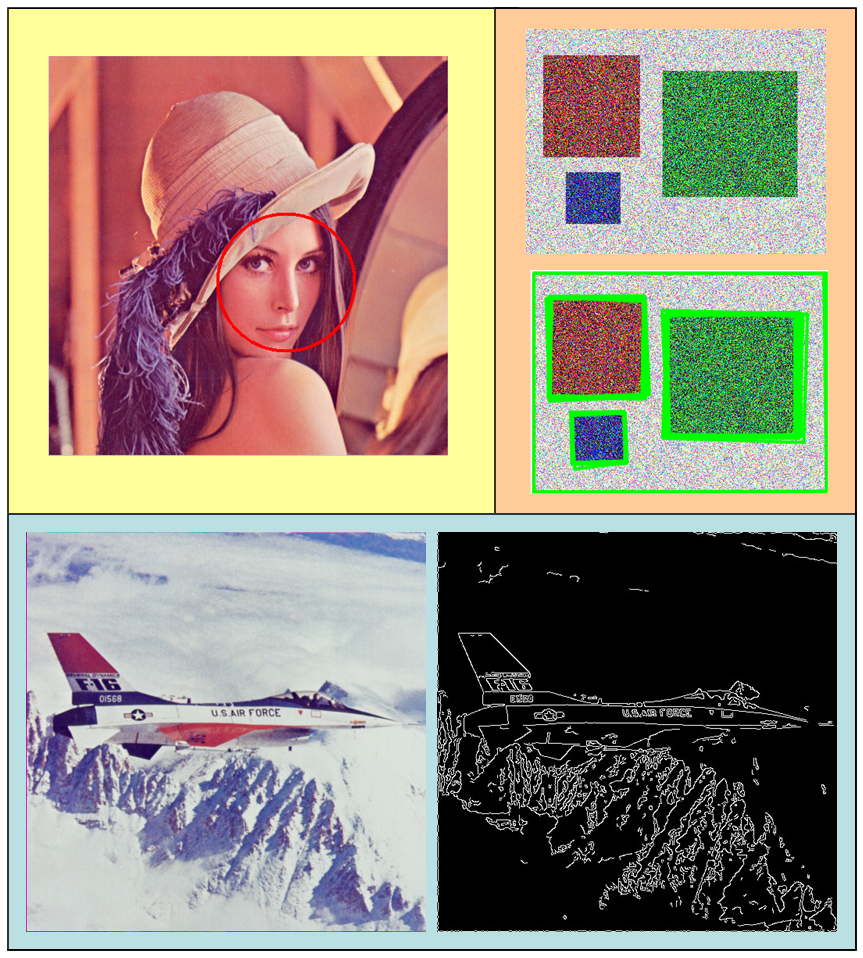
| Figure 1. Among OpenCV's many capabilities are face detection (top left), contour detection (top right), and edge detection (bottom) |
Features
OpenCV offers so many capabilities that it can feel overwhelming at first. The good news is that you only need a handful to get started, and this series walks you through a useful subset.
Below is an overview of the main functionality categories in OpenCV version 1.0, which had just been released at the time of writing:
General computer-vision and image-processing algorithms (mid- and low-level APIs)
With these interfaces you can try out many standard computer-vision algorithms without writing them yourself. They cover edge, line, and corner detection, ellipse fitting, image pyramids for multiscale processing, template matching, several transforms (Fourier, discrete cosine, and distance transforms), and more.
High-level computer-vision modules
OpenCV provides several high-level capabilities. Alongside face detection, recognition, and tracking, it offers optical flow (using camera motion to determine 3D structure), camera calibration, and stereo.
AI and machine-learning methods
Computer-vision applications frequently need machine learning or other AI techniques. A number of these are provided in OpenCV's Machine Learning package.
Image sampling and view transformations
Processing a group of pixels as a single unit is often useful. OpenCV offers interfaces for extracting image subregions, random sampling, resizing, warping, rotating, and applying perspective effects.
Methods for creating and analyzing binary (two-valued) images
Binary images are common in inspection systems that look for shape defects or count parts. A binary representation also makes it easier to locate an object to grasp.
Methods for computing 3D information
These functions help with mapping and localization, whether using a stereo rig or multiple views from a single camera.
Math routines for image processing, computer vision, and image interpretation
OpenCV bundles commonly used math algorithms from linear algebra, statistics, and computational geometry.
Graphics
These interfaces let you draw on images and write text over them. Beyond fun and creative uses, they are handy for labeling and marking. For instance, if your program detects objects, labeling images with their sizes and locations is helpful.
GUI methods
OpenCV comes with its own windowing interfaces. Although they are limited compared with what each platform can do natively, they offer a simple, cross-platform API for displaying images, accepting mouse or keyboard input, and implementing slider controls.
Datastructures and algorithms
These interfaces let you efficiently store, search, save, and manipulate large lists, collections (also called sets), graphs, and trees.
Data persistence
These methods offer convenient interfaces for saving various types of data to disk and retrieving it later.
You'll find the links to these tutorials below
http://www.cognotics.com/opencv/index.html

1 comments:
cái rồi thân thể hóa thành hồng mang, nhắm về phía không trung mà bắn tới.
Trên hồng mang, một khí tức bắt đầu tràn ngập, lực lượng cường hãn này khiến cho Bàn Thiên Lão Ma, Kim Long năm người bọn họ cũng cảm nhận được, hông mang này ngập trời, cho dù năm người bọn họ liên thủ cũng không thể nào chống lại được.
- Phụt.
Một luồng lực lượng khổng lồ ba động, sau đó màn hào quang của năm người Bàn Thiêdongtam
mu private
tim phong tro
http://nhatroso.com/
nhac san cuc manh
tổng đài tư vấn luật
http://dichvu.tuvanphapluattructuyen.com/
văn phòng luật
tổng đài tư vấn luật
dịch vụ thành lập công ty
http://we-cooking.com/
chém gió
trung tâm ngoại ngữn Lão Ma liên thủ trực tếp bị hồng mang phá vỡ, một luồng lực lượng kích tán, thân thể của năm người bay ngược đi.
Mà trong năm người, thân thể của Bàn Thiên Lão Ma rút hơn nghìn thước, Phá Ngọc, Lạc Mộc thì rút hơn ba nghìn thước, máu tươi chảy ra, bọn họ như đã bị thương.
Cô nương kia sau khi biến thành hồng mang hóa thành một con chim thật lớn, tung bay hai cánh tấn công về phía Nhạc Thành.
Post a Comment